A comparison says a source-to-bundle relationship is inferred. You ask for a short summary, and its confidence becomes derived. Nothing about shortening that result has made the original inference more certain.
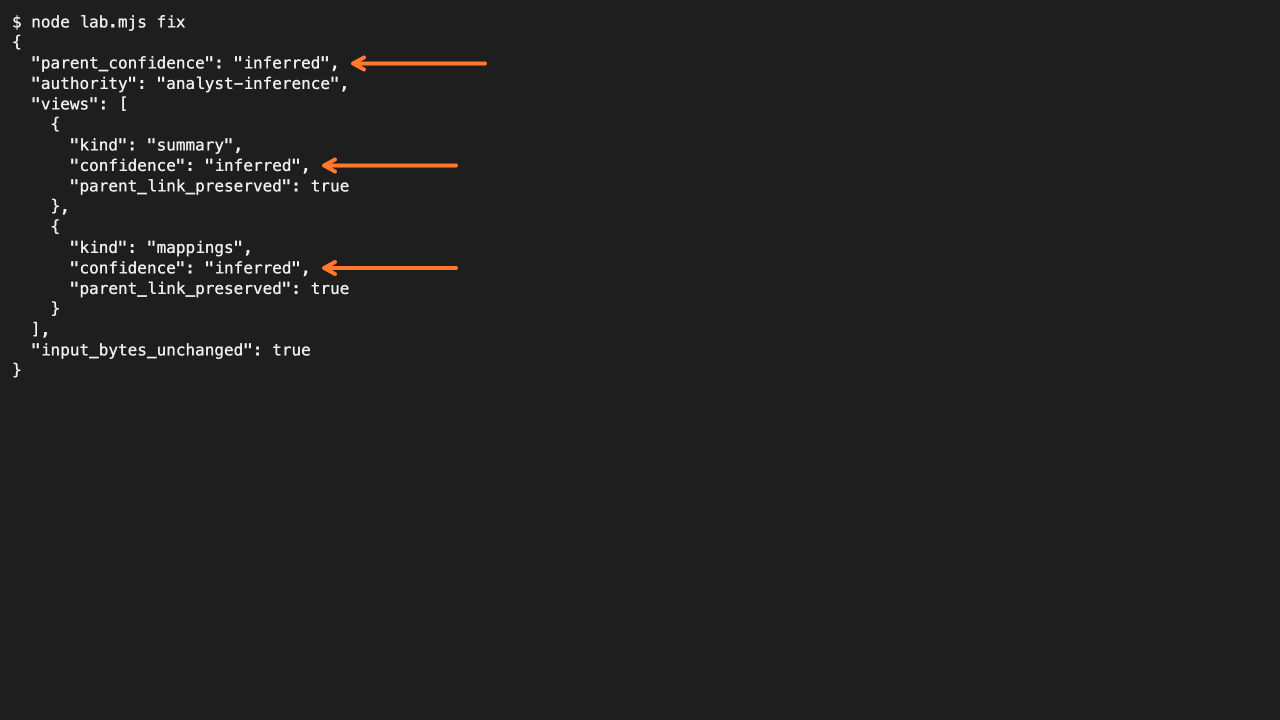
That happened in our reproduction with published REA 6.8.0. The tested source build preserves inferred confidence in both the summary and a page of mappings. It also keeps the parent’s authority and evidence link.
Why the wrapper matters
REA places confidence on the Evidence envelope, outside the normalized payload. If you inspect only the inner mapping or copy just the summary, you can miss a disagreement between the result and its wrapper.
This guide checks the actual CLI result at both levels. It does not demonstrate a downstream verification bypass or claim every Evidence-producing tool has been tested.
What we tested
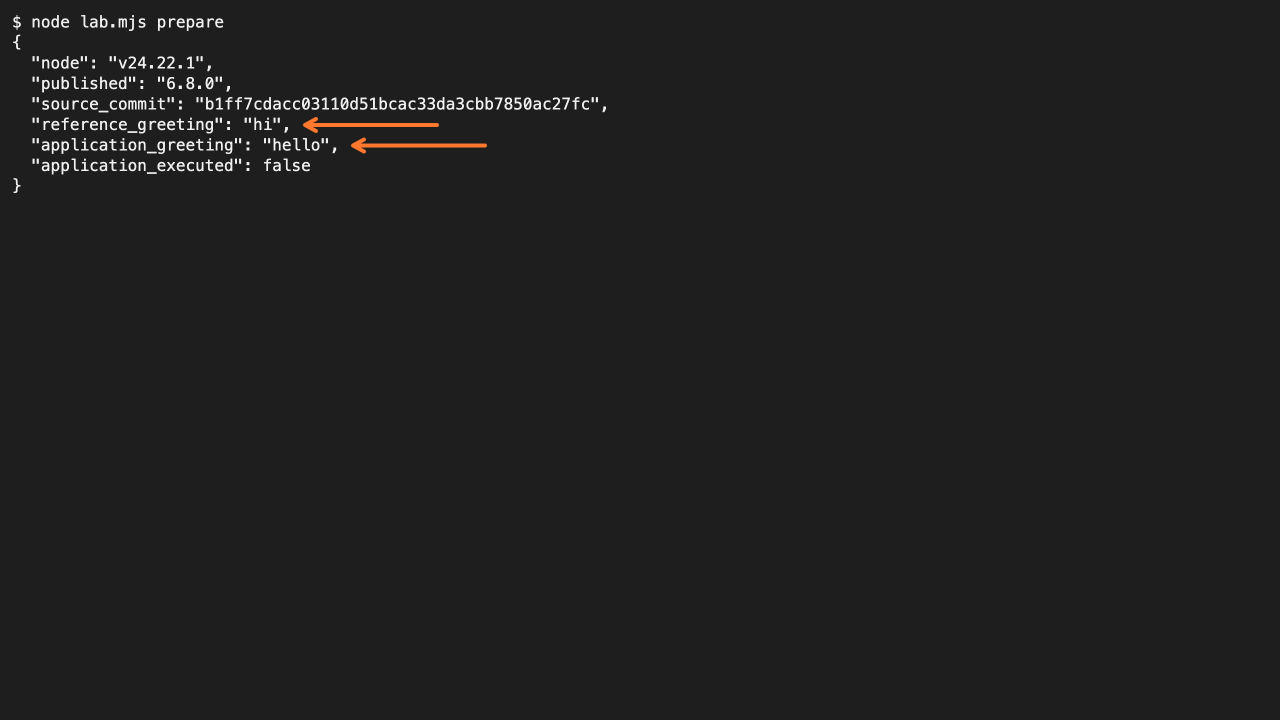
Our reference fixture returns hi; the application fixture returns hello. We import the reference, analyze the application, compare them, and request two views of that comparison. Neither JavaScript application is executed. A separate application-analysis view acts as the non-inferred control.
The comparison used Node 24.22.1 on macOS 26.6.2 arm64, published rea-agents@6.8.0, and source commit b1ff7cdacc03110d51bcac33da3cbb7850ac27fc. Both manifests say 6.8.0; the version string alone does not identify the fix. We have not established which later npm release first includes it.
Every numbered step includes a real terminal screenshot of the test harness output, with arrows only. The downloadable test kit retains the full CLI responses and executable assertions. The fixtures are deliberately small so the checked behavior is clear.
1. Create a small reference and application pair
Extract the kit as rea-confidence-test. With Node 24.22.1 active, build a sibling source checkout and install the pinned comparison package:
git clone https://github.com/morluto/rea.git rea-upstream-test
cd rea-upstream-test
git checkout b1ff7cdacc03110d51bcac33da3cbb7850ac27fc
npx --yes npm@11.16.0 ci
npx --yes npm@11.16.0 run build:cached
cd ../rea-confidence-test
npm ci
node lab.mjs prepare
Set REA_SOURCE to the source checkout path if it is elsewhere.
The kit writes two small JavaScript trees whose greeting differs. Preparation verifies the pinned source revision. The test imports and parses these files as data; it never runs their console.log call.
2. Reproduce the confidence change
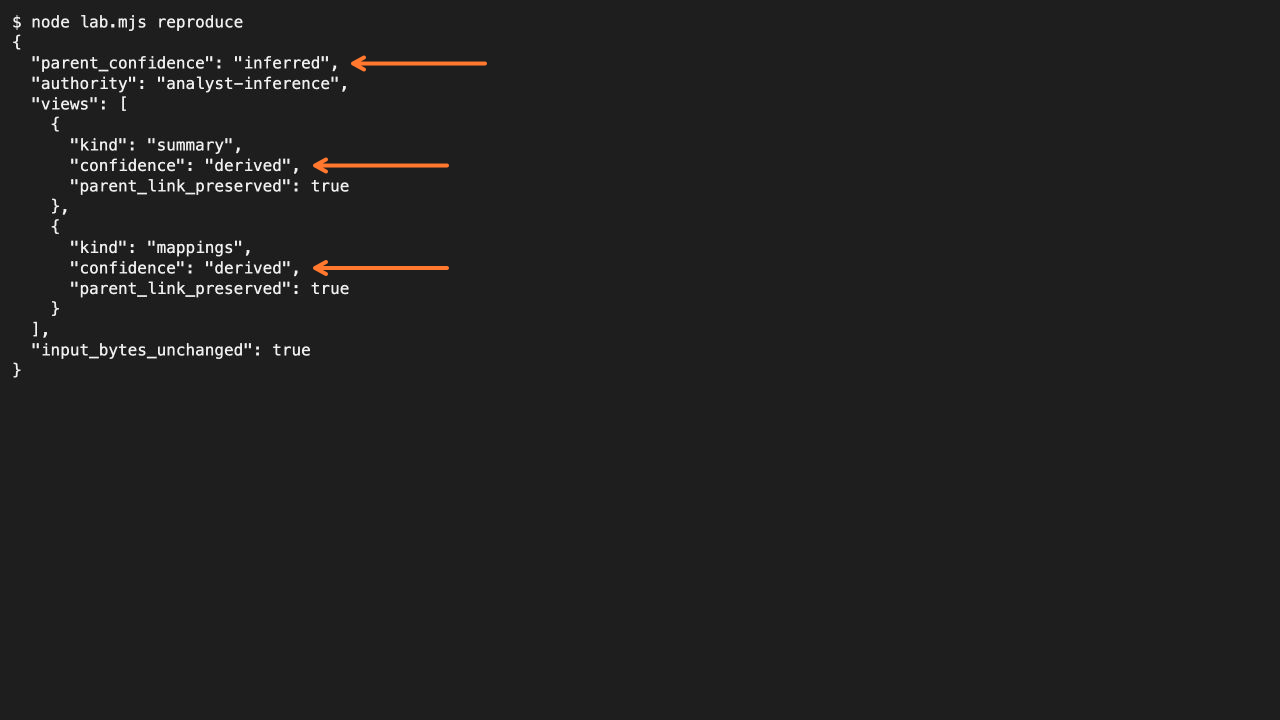
node lab.mjs reproduceThe harness runs import-reference-source, analyze-javascript-application, and compare-source-to-bundle. It then requests a summary and a one-item source-to-bundle mappings page with inspect-analysis-view.
The parent is inferred, but both published-release views say derived. The authority remains analyst-inference, and the parent links survive. Keeping those fields does not excuse the confidence change.
3. Check the fixed views and their parent links
node lab.mjs fixBoth source-build views must say inferred. The test also requires their authority to equal the parent’s authority and evidence_links to contain its exact Evidence ID.
A file-backed summary request looks like this:
{
  "source": {"kind":"evidence-file","path":"/absolute/path/comparison.json"},
  "view": {"kind":"summary"}
}
Pass that JSON request to inspect-analysis-view using the source checkout. Keep the original parent result when exporting a view. This test checks CLI file-backed views; it does not claim an independent MCP transport test.
4. Keep ordinary projection behavior intact
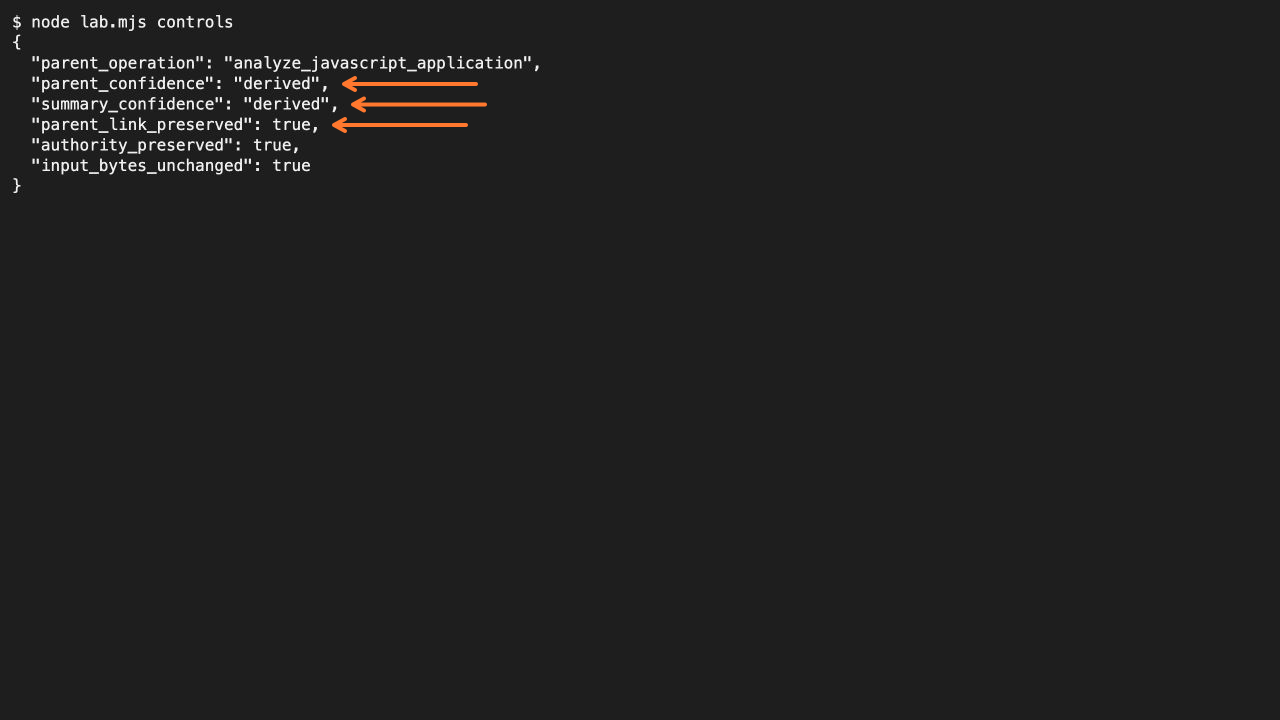
node lab.mjs controlsThe control analyzes the application directly, then requests its summary. Its non-inferred parent still produces a derived summary with the same authority and a link back to the parent.
The correction is not “all summaries are inferred.” A view should preserve the uncertainty inherited from the facts it projects. If you previously stored affected inferred-parent views, regenerate them from the retained parent rather than editing the confidence field by hand; Evidence IDs bind their content.
For a broader investigation, keep the evidence checklist beside the result and preserve unknowns when following relationships.